Search “runner’s knee” and you’ll get a list: it’s patellofemoral pain, it’s caused by weak glutes or poor tracking or overtraining, try these five exercises. That list isn’t wrong. It’s also not useful, because it doesn’t tell you which cause applies to you – and the fix for one is close to irrelevant for another.
In practice, almost every case of runner’s knee I see at Summit studio falls into one of three patterns. This is how I actually tell them apart, and why guessing wrong wastes months.
The three patterns
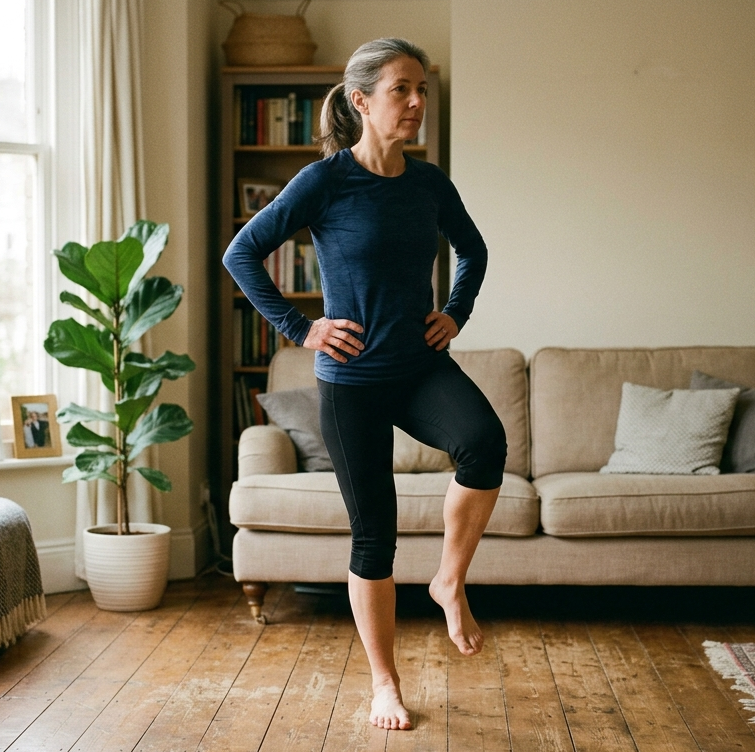
1. The hip-control case. Pain sits around or slightly below the kneecap, worse on downhills or stairs, and it’s almost always accompanied by a hip that drops or rotates when the runner stands on one leg. The knee isn’t the problem – it’s absorbing sideways load because the hip and glute aren’t controlling the leg properly on impact. Tell: stand on one leg, hands on hips, and watch in a mirror or on video. If your opposite hip visibly drops or your knee caves inward, this is your pattern.
2. The tissue-capacity case. Pain builds gradually across a training block, often coinciding with a jump in volume or the introduction of hills or speed work. There’s no obvious hip control issue – the movement looks fine. The knee simply hasn’t built the capacity to absorb the new load yet. Tell: did the pain start within 1–3 weeks of a genuine increase in volume, intensity, or new terrain? If yes, and your single-leg control looks normal, this is more likely your pattern.
3. The tracking/alignment case. Pain is more consistent, less tied to a specific load spike, sometimes present even walking down stairs, and often linked to a foot that rolls inward noticeably when standing or a longstanding history of the same knee bothering you on and off for years. Tell: has this same knee flared up multiple times over a year or more, independent of any specific training change, and does your foot visibly roll inward when you stand normally? That combination points here.
These aren’t always perfectly distinct – some runners have overlap. But most cases have one pattern that’s clearly dominant, and that’s the one worth addressing first.
Why it matters which one you have
Hip-control case: the fix is single-leg strength and control work – step-downs, single-leg balance progressions, glute-focused loading. Generic quad-strengthening exercises (the most commonly recommended “runner’s knee fix” online) do very little here, because the quad usually isn’t the limiting factor.
Tissue-capacity case: the fix is backing off volume or intensity temporarily, then reintroducing load more gradually than the schedule that caused the flare-up. Strength work matters here too, but the primary lever is training load management, not exercise selection – adding strength work without addressing the load spike that caused it usually doesn’t resolve it.
Tracking/alignment case: this is the one most likely to need a proper look at foot posture and, sometimes, footwear – and it’s the pattern where a generic exercise list is least likely to work on its own, because the driver is often structural rather than a simple strength deficit.
Give a hip-control case a program built for tissue-capacity and nothing improves, because you never addressed the actual driver. This is the single most common reason I see runners who’ve “tried everything” for runner’s knee and got nowhere – not because nothing works, but because they were treating the wrong pattern.
A case from clinic
A runner came in having completed PT-prescribed quad strengthening for six weeks with zero improvement – knee pain every run, worse on the local hills he trained on. The exercises weren’t wrong in general, they were wrong for him. On a single-leg squat, his hip dropped noticeably and his knee caved inward the moment he descended – a clear hip-control pattern, not a quad-strength or tissue-capacity issue.
We dropped the quad work entirely and replaced it with single-leg step-downs and glute-focused loading, done slowly and controlled rather than fast and high-rep. Running volume didn’t change. Within four weeks the downhill pain had reduced by more than half, and by week seven he was training normally. Nothing about his running load changed – only the identification of which pattern he actually had, and the exercises changed to match it.
How to check which pattern you’re in
The single-leg stand test above is the fastest way to check for the hip-control pattern specifically, but it’s one of four checks I run through with every runner before building a program – ankle, hip, rotation, and foot posture together, because these patterns often overlap with restrictions elsewhere in the chain. My free interactive self-screen covers all four in about two minutes. (A free interactive version of this self-screen is coming soon – in the meantime, the single-leg stand test above is the one to start with.)
Reading your result against the three patterns above: a flagged result on the hip/balance check lines up with the hip-control case. A flagged ankle or rotation result, with a clean hip/balance check, points more toward the tracking/alignment case, especially if your foot posture check also flagged. A clean result across all four, with pain that tracks a recent jump in training load, points toward the tissue-capacity case – here the screen is really ruling things out rather than in.
The bottom line
“How to fix runner’s knee” isn’t really answerable in general, because there isn’t one runner’s knee – there are at least three different mechanical stories that produce the same symptom in the same location. The exercises that fix one can do nothing for another. Working out which pattern you actually have, not just that your knee hurts, is the part that actually determines whether six weeks of exercises helps or wastes your time.